
Proven in the Field: Why retroGLAZE invests in Independent Window Testing
When you buy windows or retrofit double glazing, you’re really buying three things:
- Warmth and comfort
- Protection from the weather
- Confidence it will keep performing for years.
Most window systems look similar in a brochure. Where they differ is how hard they’ve been pushed before anyone installs them in your home or building.
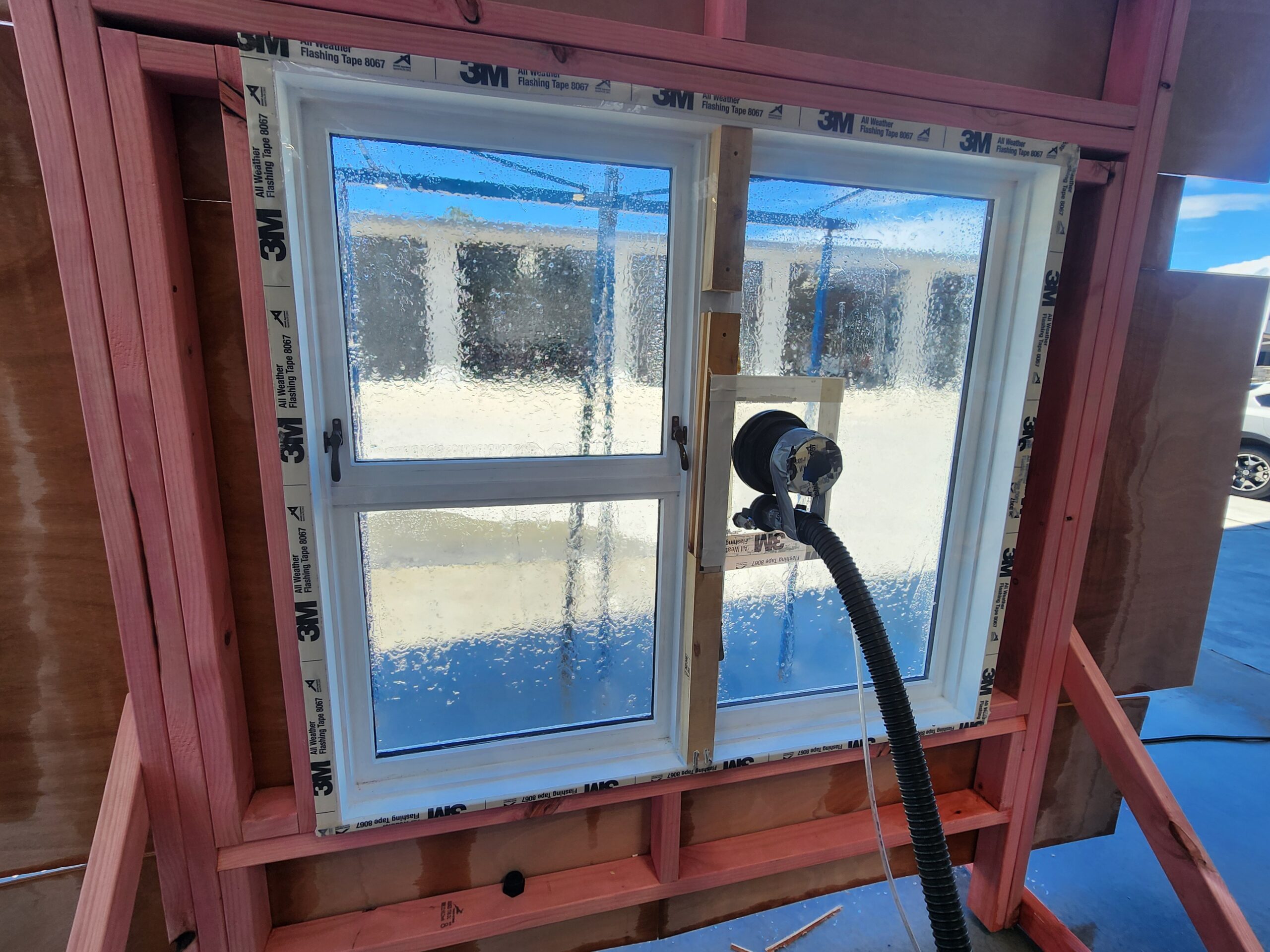
What is WGANZ 502 Field Testing and why is it crucial?
The NZ Window & Glass Association’s WGANZ 502 test method is a recognised New Zealand field test for newly installed fenestration products (ie windows). In simple terms, the test process is carried out by an accredited test engineer and involves:
- Mounting a calibrated spray rack outside the test window to deliver controlled waterflow
- Applying negative air pressure from inside using a vacuum chamber
- Measuring performance at NZS 4211 specified test pressures to check for water penetration under realistic, wind-driven rain conditions
In other words, it’s not a quick hose-down.
It is a systematic way to confirm that the window, the glass and glazing system, and the installation details work together to keep water out at the design pressure. It can also be used to identify any weaknesses so they can be fixed or designed out.
For our network, the WGANZ 502 Field Test provides:
- An industry-accepted, independent benchmark for different window types and their components
- Confidence for engineers, councils and building owners that performance has been checked in the field
- Feedback to improve our designs and installation details
How we apply this to aluminium and timber window products
In late 2025 we used independent WGANZ 502 Field Testing in two key areas of our product development:
- High-performance aluminium for a Wellington high-rise
- OMEGA® 800 Series thermally broken replacement window, configured for a 3.2 kPa SLS specific design wind load.
- Prototype developed in collaboration with a facade engineer, Wellington Glass & Mirror and The Double Glazing Company (Central Plateau).
- WGANZ 502 Field Testing, proving the window met the engineering specification, passing with no water ingress (the window was then tested and passed at an exceptionally high SLS design wind pressure of 7.5 kPa).
- New timber sash and weather-seal designs for retrofit double glazing
- Fixed, casement and split-rail sashes developed at our Taupō facility
- Tested progressively across Low, Medium, High, Very High, Extra High and Extreme NZS 4211 wind pressures
- Further stepped up to a specific design SLS > 9 kPa, with no water ingress recorded for the confirmed solutions
For our engineering team, these results are a validation of the design process: from concept sketches and CAD profiles, through manufacturing and assembly, to real-world testing that simulates the sort of wind-driven rain that New Zealand is known for.
Our Taupō-based product development and manufacturing facility
To support this approach, RetroGlaze Network has invested in a dedicated product development and manufacturing facility in Taupō. This gives us:
- A controlled environment to build and refine prototype windows and sashes
- The ability to run in-house checks before independent testing
- A central hub where experience from partners around the country can be brought together
From here, we can develop solutions that our local RetroGlaze Partners can take into homes and buildings nationwide, knowing that the underlying designs have been through a robust test regime.
What “independent testing” means for your project
If you’re a homeowner, architect, engineer or property manager, independent testing translates directly into practical benefits:
- Reduced risk of leaks – designs are verified at the intended wind pressures.
- Better documentation – test reports support consent and sign-off processes.
- Long-term performance – when the design, glazing and installation details are right, the system is less likely to cause problems later.
- Clarity between options – you can compare solutions based on more than just price and appearance.
Most importantly, you can choose a RetroGlaze Network partner knowing you’re not buying an unproven experiment. You’re tapping into a network that invests in doing things properly – design, testing, refinement – before your windows ever arrive on site.
If you’d like to know whether your next retrofit double glazing or replacement window project could benefit from an independently tested solution, talk to your local RetroGlaze Partner. We’re always happy to walk you through the options.
Questions homeowners often ask
What’s the difference between an NZS 4211 test and a WGANZ 502 field test?
In simple terms, they look at the same issues from two different angles:
- NZS 4211 (and SNZ TS 4211) is the New Zealand performance standard / technical specification for windows. It sets out how a representative window is tested, in a specialist laboratory, for:
- strength and stiffness
- air leakage
- weathertightness (water penetration)
- operation of opening sashes
The result is a performance classification for a given wind zone, and it’s the pathway recognised in the Building Code for window compliance.
All replacement window joinery installed by a RetroGlaze® Partner has been system-tested here in New Zealand in accordance with NZS 4211.
- WGANZ 502 Field Test is a field test. It provides a way of checking the performance of newly installed windows or window components in a real building application. It uses:
- an external spray rack to apply a controlled water spray
- an internal vacuum chamber to apply a specified negative pressure
Together, that simulates wind-driven rain on the actual installed window, flashings and junctions, not just a lab sample.
RetroGlaze Network has completed a number of WGANZ 502 Field Tests in collaboration with independent test engineers and our customers in order to test and prove installed window solutions and
You can think of NZS 4211 as proving the window system design, and WGANZ 502 as proving the installed window and details on your building.
Within the RetroGlaze Network we value both:
- NZS 4211 classification to the right wind zone (or specific design) and
- WGANZ 502 Field Tests for projects or new window components, in collaboration with customers.
How is this relevant for the windows in my home?
Even if your home never has a test rig bolted to it, you still benefit directly:
- All of the replacement window and door solutions we offer are based on designs that have been through this kind of testing – in the lab and, where appropriate, on real buildings.
- A number retrofit window components, such as our Replacement Timber Sashes, have been Field Tested to provide real-world evidence of their appropriateness as a solution for New Zealand homes.
- When we specify a solution, we’re not guessing. We’re drawing on NZ Standards, test reports and engineering work done on similar window types, profiles and details.
- If your home is in a higher-risk location – coastal, high on a hill, or with very large or exposed windows – we can step up the design accordingly because we already understand how these systems behave under higher wind and water loads.
In other words, the work we do on larger technical projects and product development feeds back directly into better, more reliable solutions for ordinary New Zealand homes.
Do all homes need a WGANZ 502 Field Test on their new/ upgraded windows?
No, and in most cases we wouldn’t recommend it.
For a typical detached home where:
- the site wind zone is known
- the windows are within the normal size range
- we’re using systems appropriately classified to NZS 4211 for that wind zone
a WGANZ 502 field test would usually be overkill.
Where it becomes valuable is when:
- the building is multi-storey or very exposed
- there are complex junctions (balconies, cladding interfaces, unusual geometry)
- the project team wants a documented quality assurance check on a sample of the installed windows
For those projects we’re comfortable working with facade engineers and independent testers to build targeted field tests into the programme.
Does this level of testing make my project more expensive?
There is a real cost to doing proper product development and independent testing – we have to:
- design and build prototypes
- pay accredited labs and field testers
- refine details and sometimes go back for additional testing
But we spread that cost across the whole RetroGlaze Network and across many projects, rather than loading it all onto one homeowner.
For you, it usually works out as:
- a small premium for a better-engineered, better-detailed solution
- a large reduction in risk of leaks, call-backs and remedial work later
Most clients would rather pay slightly more up front than face the cost and disruption of fixing a failed window or leaky façade later.
How can I tell if the windows I’m being offered are properly tested?
Good suppliers should be happy to answer these questions:
- “What NZS 4211 (or SNZ TS 4211) classification does this window system have, and for which wind zone?”
- “Has this system been tested or used successfully on sites similar to mine?”
- “Have you (or your network) done any WGANZ 502 field tests on comparable installations?”
As part of the RetroGlaze Network, our partners can talk you through:
- the NZS 4211 classifications that sit behind the products they use
- any relevant field testing and engineering that has been done
- how those results have influenced the details they’ll use on your home
If you’d like that reassurance for your own project, just ask. We’d rather show you how we back our solutions than expect you to take them on trust.