
Timber Technology: What is thermally modified timber?
Timber naturally responds to the moisture in the air. As humidity rises and falls, it absorbs and releases moisture, causing it to swell and shrink. Over time, excessive movement can contribute to timber twisting, cupping or warping—and, in a window sash, can place added stress on joints, glazing seals, weather seals and painted surfaces.
Thermal modification changes how strongly the timber responds to moisture. Before the timber is made into Escence Wood sashes, New Zealand-grown radiata pine is heated to approximately 230°C in a carefully controlled environment. Steam helps maintain the correct conditions and keeps oxygen levels low enough to prevent the timber from burning.
This is much more than simply drying the wood. The controlled heat permanently changes parts of the timber’s cellular structure, reducing its ability to attract and absorb moisture from the surrounding air. Once cooled and conditioned, the timber reaches a lower moisture content and responds less dramatically when atmospheric conditions change.
Sustainably grown NZ timber is thermally modified right here
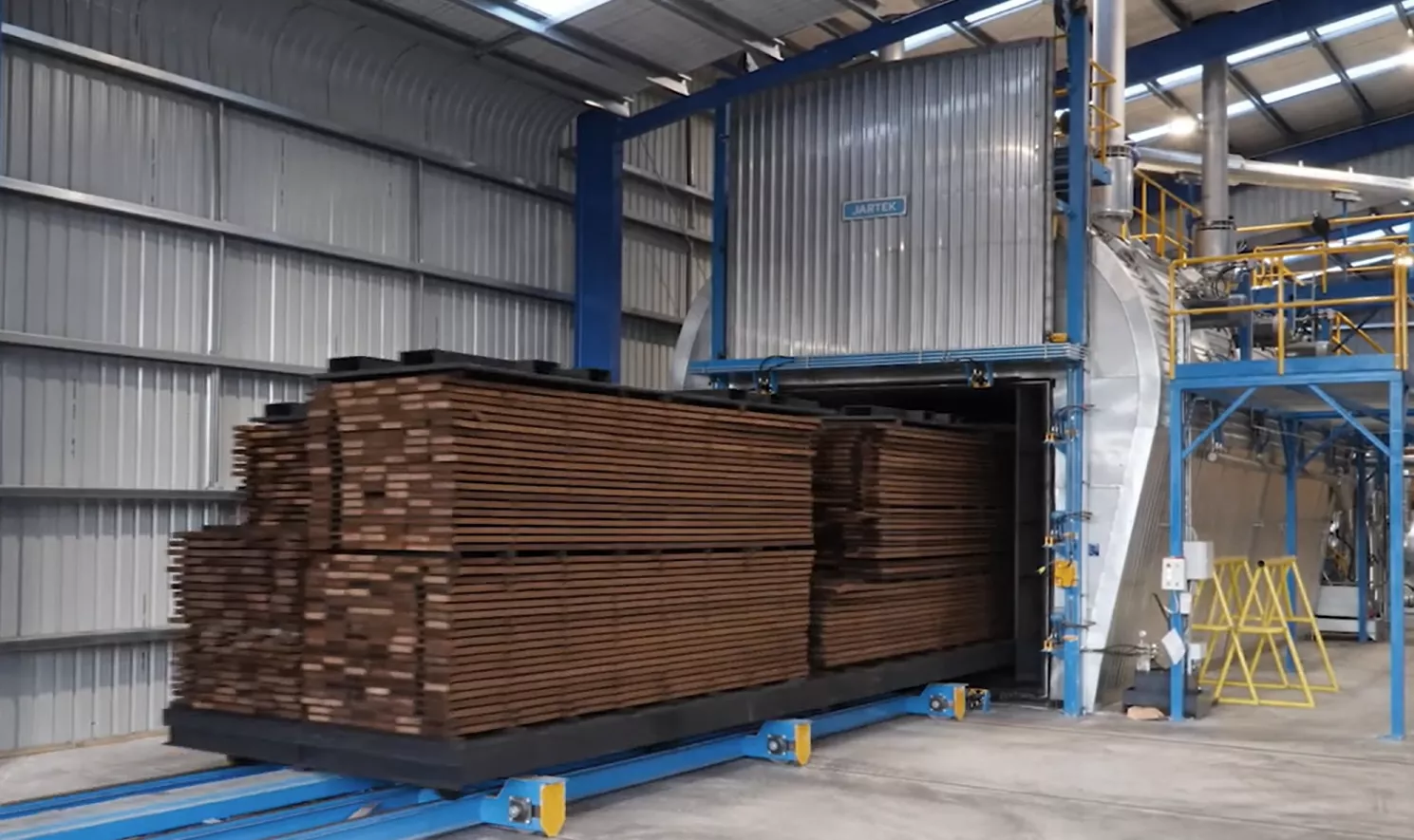
Just thirty minutes drive from the Escence Wood™ factory in Taupo, the thermal modification process takes place. Located in the heart of the Waikato, the Jartek thermal modification plant from Finland completes a computer-controlled process to significantly change the properties of the timber. Through this process, sustainably grown New Zealand pine (radiata) becomes a wood with structural and durability properties similar to “old-growth” wood such as Western Red Cedar.
The Escence Wood™ process of lamination and Azoles H3.1 treatment provides further improvement to the structural stability, strength, and durability.
An internationally proven process
Thermal modification is an internationally established timber-improvement process, supported by decades of research, testing and commercial use. Although heat treatment of wood has a much longer history, the modern industrial process was developed in Finland during the 1990s, when the VTT Technical Research Centre of Finland worked with the timber industry to refine a controlled heat-and-steam method that could be reliably applied at commercial scale.
ThermoWood® became the best-known international name associated with this Finnish development and helped establish recognised process controls, quality assurance and technical guidance for thermally modified timber. ThermoWood® is a registered trademark available only to authorised members of the International ThermoWood Association, rather than a generic name for all thermally modified timber; however, its extensive research and international use provide useful context for understanding the established science behind the TM230 process used here in New Zealand for Escence Wood™.
The benefits of thermal modification for New Zealand grown radiata pine
The principal benefit is improved dimensional stability. In plain language, the timber is less inclined to swell when conditions become humid or shrink when they become dry. It is still real timber and will continue to respond naturally to its environment, but the amount of movement is significantly reduced.
That stability is particularly valuable in a window sash. Window sashes are exposed to changing indoor and outdoor temperatures, sunlight, humidity and weather. Using thermally modified timber helps the sash maintain its shape and dimensions, supporting consistent operation and reducing movement around its joints, double glazing, weather seals and coating system.
Heating the radiata pine to approximately 230°C does more than improve its stability. The specified thermal modification process permanently changes the timber’s chemistry, reducing both its ability to hold moisture and the amount of hemicellulose available as a food source for decay fungi. This makes the timber less favourable for fungal growth and gives it greater natural resistance to decay.
What this means for Escence Wood™ replacement timber sashes
For Escence Wood™, thermal modification is the starting point rather than the entire solution. The timber is then further engineered through lamination, helping to balance the natural grain and improve the consistency and stability of the finished components. It is then precision-profiled, Azoles H3.1 treated and protected with a specified paint system to provide further durability in its intended exterior application.
These processes perform different but complementary jobs. The thermal modification improves moisture resistance, and dimensional stability and resistance to fungal decay. The engineered construction adds further stability and consistency, while the H3.1 treatment and maintained paint system further protect the timber against decay and weather exposure.
The result is a new, made-to-measure Escence Wood™ sash designed specifically for high-performance double glazing and weather sealing. Applied in Timber Sash Replacement, this allows suitable existing timber window frames to be retained while the old sashes are replaced, preserving the character and proportions of the home with a more stable, purpose-engineered timber sash.